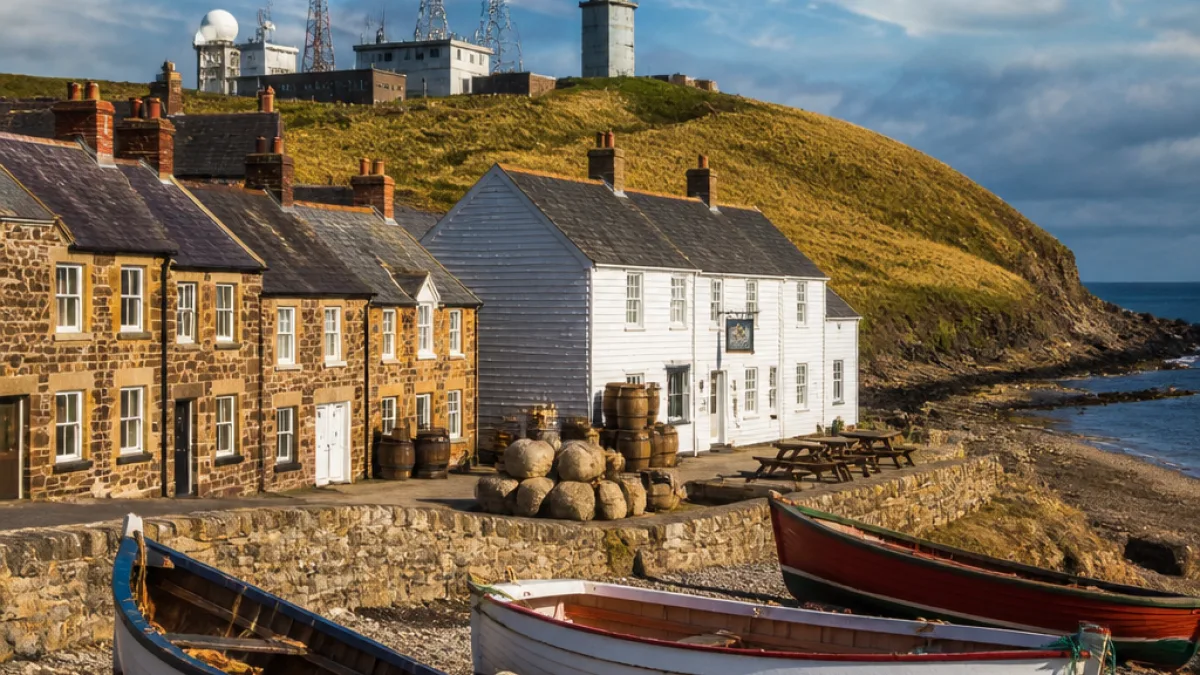
On a narrow strip of coastline between Alnmouth and Craster lies Boulmer, a settlement little more than a row of cottages and a pub facing the North Sea. The village’s modest present-day appearance masks a layered history – from an 18th- and 19th-century reputation as a smuggling hub to its Cold War role as home to one of Britain’s key radar and control stations.
Fishing, smuggling and a long coastline
For centuries Boulmer held a role very different from the sleepy picture you see today. In the 18th and 19th centuries the village gained a reputation as the "smuggling capital of Northumberland", with spirits, salt and tobacco moved through the local pub, the Fishing Boat Inn. The illicit trade was linked with figures who travelled from across the border; the village once dealt with a colourful mix of traders and travellers drawn to its remote shore.
Even now, despite the passage of time, Boulmer preserves elements of that maritime life. There is no harbour; instead, blue-painted fishing boats are still hauled up onto the beach. Seasonal catches such as crab, lobster and sea salmon remain part of the local economy and identity, and the village is often described as one of the last true traditional fishing communities on the Northumberland coast.
RAF Boulmer and the village’s wartime transformation
Just inland from the cottages, RAF Boulmer operates a round-the-clock surveillance role, feeding into national airspace monitoring. Its presence is an unlikely but enduring neighbour to the tiny coastal community.
The RAF connection began during the Second World War when land near the village was requisitioned for a decoy airfield. The decoy included grass runways, dummy aircraft and ammunition stores and was intended to draw German attacks away from other bases in the area. Luftwaffe raids struck the site in 1940 and 1941. In March 1943 the location was upgraded to a full operational airfield and hosted Spitfire training flights from No. 57 Operational Training Unit.
The wartime airfield closed in 1945 and the land briefly returned to agriculture. But the strategic importance of monitoring airspace returned with the early Cold War. In the early 1950s the RAF built a protected underground radar and control centre on the site; by the mid-1950s Boulmer had been designated one of just nine master radar stations in the UK. Over subsequent decades its radars fed data into Britain’s air defence picture, cementing the base’s role in national security.
Place, people and continuity
Today the village and the station sit in close proximity, a juxtaposition of quiet coastal life and an operational military facility. That contrast is part of what makes Boulmer distinctive on the Northumberland coast: a tiny, traditional fishing settlement that has changed little in more than a century yet shares its space with sophisticated, modern radar operations.
- Location: Between Alnmouth and Craster on the Northumberland coast
- Historic roles: Fishing village; 18th/19th-century smuggling activity
- RAF presence: Decoy airfield in WWII; upgraded to operational airfield 1943; Cold War radar and control centre from early 1950s; one of nine master radar stations by mid-1950s
| Feature | Detail |
|---|---|
| Local name | Boulmer (pronounced "Boomer") |
| Main community assets | Fishing cottages, the Fishing Boat Inn, beach where boats are hauled ashore |
| RAF role | Radar and control centre providing continuous air surveillance |
Boulmer is a reminder that Northumberland’s coastline still holds places where long-standing livelihoods and national infrastructure coexist. For local residents the village is a familiar landmark of tradition and service: trawlermen hauling nets and an RAF station watching the skies.
Its story illustrates how small communities can retain character even while adapting to strategic demands placed upon them by wider national concerns. In Boulmer that adaptation is visible in the quiet streets and the radar towers beyond them — a blend of heritage, maritime life and defence that remains distinctly Northumberland.