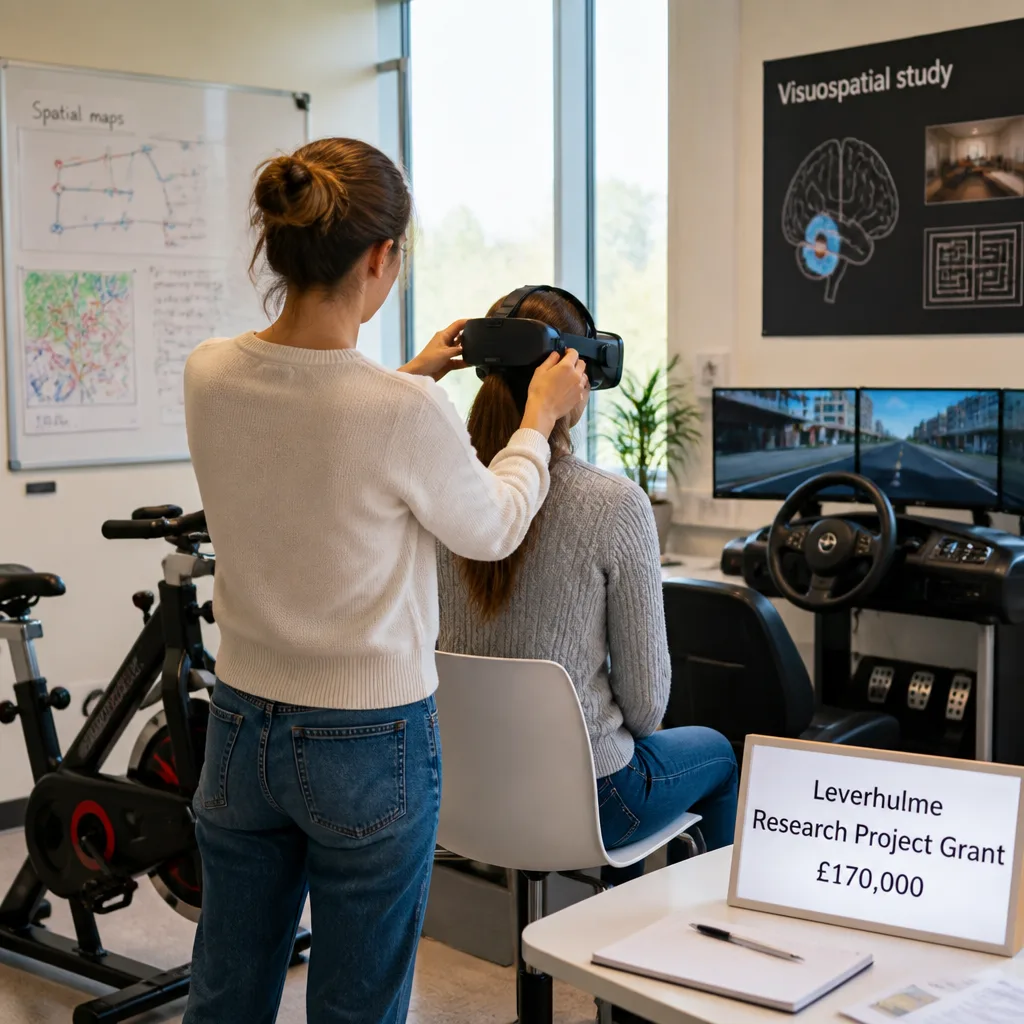
Bucks New University has secured a £170,000 research award to investigate whether a sedentary lifestyle alters the brain’s ability to process visual information and navigate space — a question with clear implications for everyday activities such as driving, moving around the home and reacting to hazards.
Research focus and scope
The two-year project, titled Visuospatial processing: Consequences of Physical Inactivity, is led by Professor Brandon S. Shaw and funded by the Leverhulme Trust. It will explore connections between low levels of physical activity and changes in visual cognition and spatial awareness, concentrating on midlife when patterns of activity often shift.
Launching in early 2027, the study will run in partnership with the University of Essex and form a core strand of the newly established Centre for Integrative Lifestyle and Healthy Ageing Research (CILHAR) at Bucks. The project will also support a new postdoctoral research assistant and link to a Vice-Chancellor’s PhD studentship.
Why visuospatial processing matters
Scientists describe visuospatial processing as the brain’s ability to interpret visual information about where objects are in space and how to move through an environment. Deterioration in these skills can affect tasks we perform automatically — for example, judging distances when driving or navigating crowded places.
- Grant value: £170,000 from the Leverhulme Trust
- Duration: 24 months
- Lead investigator: Professor Brandon S. Shaw (Bucks New University)
- Partners: University of Essex and Bucks New University’s CILHAR
“This project is about understanding how inactivity affects the way we process space, react and coordinate movement. These are things we rely on every day, often without thinking about them.”
The research team will examine whether prolonged physical inactivity contributes to measurable changes in how people perceive and respond to their surroundings. With global rates of inactivity rising, researchers say there is an urgent need to understand not only the physical consequences but potential cognitive and perceptual effects too.
Academic and public-health implications
Professor Shaw, who joined Bucks in June 2026, leads work across health, performance and cognitive science. The Leverhulme award both recognises the academic promise of the project and provides the resources to build research capacity at Bucks through staffing and doctoral training.
Pro Vice-Chancellor Jermaine M. Ravalier described the funding as a significant endorsement for the university. The study’s findings could inform public-health messaging and interventions aimed at healthy ageing, particularly if links between inactivity and visuospatial decline are established.
Potential consequences of the research include:
- Designing targeted physical-activity interventions for midlife adults to preserve visuospatial skills.
- Informing road-safety and mobility guidance where impaired spatial processing may increase risk.
- Guiding future research into cognitive markers of sedentary behaviour and healthy ageing policy.
| Item | Detail |
|---|---|
| Funding body | Leverhulme Trust |
| Amount | £170,000 |
| Length | 24 months |
| Start | Early 2027 |
As sedentary patterns become increasingly common, especially among those in middle age, the study aims to provide evidence on whether reduced physical activity is simply a risk to the body or whether it also undermines fundamental cognitive processes we rely upon daily. The research will be watched closely by clinicians, transport safety experts and public-health planners eager for data to shape prevention and lifestyle advice.
By embedding the project within CILHAR, Bucks New University is signalling a long-term commitment to investigating lifestyle factors that influence ageing trajectories, combining academic inquiry with practical implications for the public.