
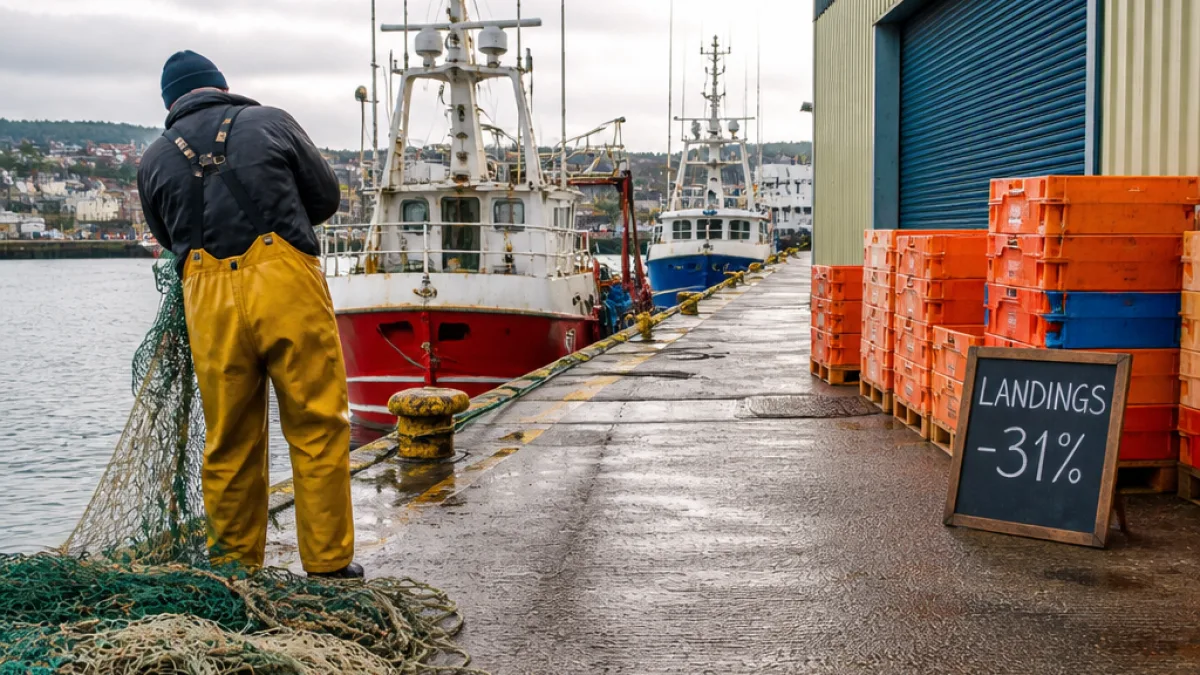
Community and industry brace for impact after significant reduction in Lerwick landings
Official statistics have revealed a 31 per cent reduction in the volume of fish landed at Lerwick in the first half of 2026 compared with the same period in 2025, prompting urgent concern from local fishing representatives over the immediate economic effect on Shetland’s largest port.
Figures published by the Marine Management Organisation also show landings across Scotland fell by 22 per cent in the same timeframe. The Shetland Fishermen’s Association (SFA) pointed squarely at substantial cuts to total allowable catches (TACs) as the principal cause.
SFA executive officer Daniel Lawson highlighted the scale of the quota reductions affecting key commercial species, noting a 44 per cent reduction in quotas for Northern Shelf cod and a 25 per cent reduction for Northern Shelf saithe. He also stressed that weather disruption and fishing days lost to maintenance and repairs had compounded the downturn.
"Numbers in government spreadsheets have real-life consequences,"
Mr Lawson said when the cuts were announced in December that the reduction in cod alone would translate into losses of around £16 million to the Shetland economy in 2026. He warned that, for a community of roughly 23,000 people, the impact would be most keenly felt in family-owned vessels and shareholder crews who depend on local landings.
The SFA has repeatedly argued that the modelling underpinning some quota decisions does not reflect what fishing crews encounter at sea. Mr Lawson called for "investment in evidence-led fisheries science" and for more rigorous, locally grounded analysis to underpin future TAC decisions.
The Scottish Government responded by saying the 2026 TACs were set following negotiations between the UK, the EU and Norway and that they were based on scientific advice alongside socioeconomic considerations. It said the reductions for Northern Shelf cod were intended to reduce fishing pressure and to support recovery of spawning stock biomass.
- Immediate effects: Reduced income for crew and owners, fewer landings through Lerwick market.
- Broader concerns: Economic consequence for ancillary businesses — gear suppliers, processors and harbour services.
- Calls for change: Industry demands better, locally focused science to inform TACs.
Local people and industry leaders are now weighing the short-term realities against longer-term sustainability aims. While stock recovery is a stated objective of the quota reductions, the sharp contraction in activity this year raises difficult questions about how rapidly social and economic harm can be mitigated in island and coastal communities.
Those on the frontline of Shetland’s fishing fleets say decisions taken in multilateral negotiations have consequences at berths and kitchen tables in Lerwick. With the town a primary hub for processing and distribution in these islands, any sustained drop in landings carries knock-on effects for employment and for the supply chain that feeds local businesses.
| Metric | Change reported |
|---|---|
| Lerwick landings (H1 2026 v H1 2025) | −31% |
| Scotland landings (H1 2026 v H1 2025) | −22% |
| Northern Shelf cod quota | −44% |
| Northern Shelf saithe quota | −25% |
Industry representatives and community leaders in Lerwick will be watching closely for any additional support measures from national authorities and for practical steps to bridge the period while stocks are expected to recover. The balance between conservation measures and the livelihoods of those who fish these seas remains a pressing local and national policy challenge.