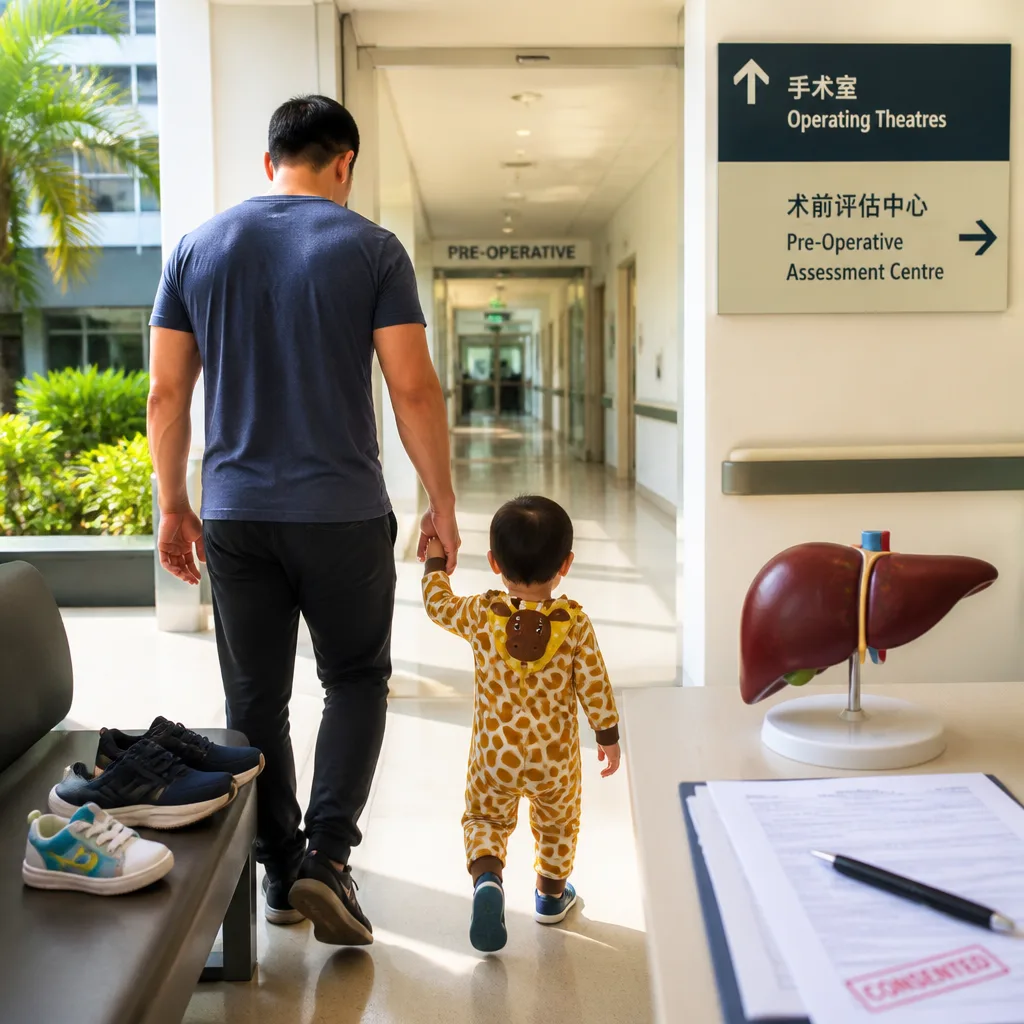
A Singaporean father has radically changed his lifestyle to qualify as a living liver donor for his three-year-old son, who was diagnosed with the rare genetic disorder Alagille syndrome and requires a transplant to survive.
From incarceration and illness to a donor journey
Noel Joshua Selvanathan, 36, told The Straits Times that when his son Isaiah was found to have the condition he initially believed he could not help. At that time he was incarcerated and had a history of substance and alcohol misuse. He also suffered from hepatitis C and fatty liver disease — conditions that initially put him outside the pool of suitable donors.
"I was incarcerated then, and having struggled with substance and alcohol abuse in the past, I was just not the right fit. I also suffered from hepatitis C and fatty liver disease, so all I could do was pray,"
The family’s case was managed across Singapore’s paediatric liver care pathway: Isaiah was first diagnosed at KK Women’s and Children’s Hospital and later referred to the National University Hospital (NUH), which is the nation’s public centre authorised to perform paediatric liver transplants. The operations are coordinated by the National University Centre for Organ Transplantation (NUCOT) together with the Khoo Teck Puat – National University Children's Medical Institute.
Clinical picture and urgency
Isaiah, now three, languished early in life with clear signs of severe liver dysfunction. S. Venkatesh Karthik, a senior consultant in the paediatric gastroenterology, nutrition, hepatology and liver transplant division at the Khoo Teck Puat institute, said Isaiah appeared markedly jaundiced, had a poor appetite and very low energy when first assessed at two years old.
"What struck me when I first saw him was how jaundiced he was. Also, his appetite was very bad and his energy was very low. He was unable to play as a child of his age should be playing,"
Jaundice — the yellowing of skin and eyes — is a common sign of liver disease. In Alagille syndrome, abnormalities in the bile ducts cause bile to accumulate, damaging the liver over time. According to the hospital team, liver transplantation is the only effective long-term treatment for many children with the disorder.
What the father had to change
Selvanathan’s path towards becoming a candidate for living donation required addressing his own medical issues and lifestyle. The publicly available account notes his prior hepatitis C infection, fatty liver and history of substance use — factors that typically preclude donation until resolved. He has since taken steps to renovate his health in order to be reassessed.
Living-donor liver transplantation for paediatric recipients is technically demanding and involves careful compatibility and fitness checks for the donor. The NUH-led paediatric programme manages complex cases for patients up to 18 years of age and maintains strict criteria to protect both donor and recipient.
Context and wider implications
Alagille syndrome is rare: clinicians quoted the condition as affecting roughly one in 70,000 people. It is typically identified in infancy or early childhood when symptoms such as jaundice or growth and developmental delays prompt investigation. For affected families, the need for transplantation places profound emotional, financial and logistical strains on caregivers — factors that can spur exceptional personal decisions, as in this case.
The family’s journey underscores broader issues in transplantation policy: the benefits of living donation, the necessity of robust donor assessment, and the social and medical supports required for parents who step forward. It also highlights the role of specialised centres — such as NUH and the Khoo Teck Puat institute — in delivering high-stakes, multidisciplinary paediatric care.
- Patient: Isaiah, aged 3, diagnosed with Alagille syndrome
- Potential donor: Father, Noel Joshua Selvanathan, 36, who changed his lifestyle and treated liver conditions to be reassessed
- Specialist centres involved: KK Women’s and Children’s Hospital; National University Hospital; National University Centre for Organ Transplantation; Khoo Teck Puat – National University Children's Medical Institute
| Item | Detail |
|---|---|
| Condition | Alagille syndrome (rare, ~1 in 70,000) |
| Child’s age | 3 years |
| Father’s age | 36 years |
This account, as reported by The Straits Times, is a reminder of the human cost of rare disease and of the extraordinary lengths families will go to secure treatment for their children. It also illustrates the interplay between personal recovery and medical eligibility in the delicate process of living organ donation.