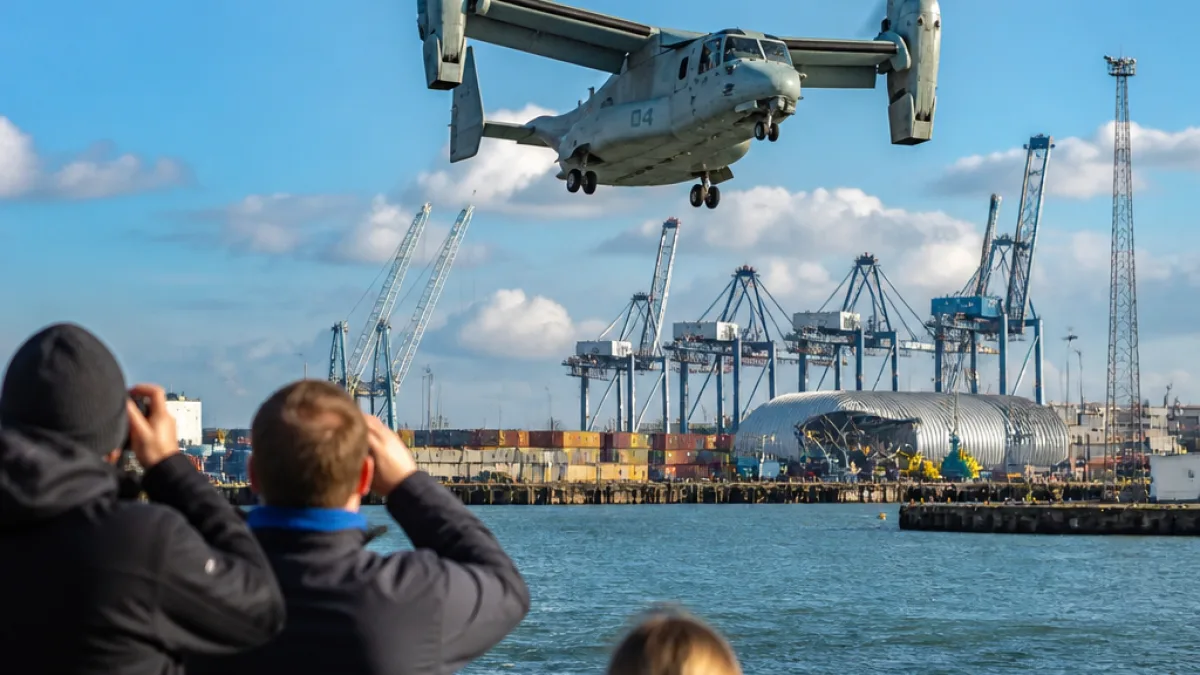
Southampton witnessed a striking display of military aviation in 2025 when a Bell Boeing V‑22 Osprey crossed Southampton Water and landed at ABP Southampton as part of a US military trial at the ABP Solent Gateway.
Port proves suitability for complex military aircraft
The visit underlined the commercial port’s function beyond freight handling, demonstrating that it can accommodate defence operations requiring specialist facilities, security and coordination. Observers on the city waterfront had an unobstructed view of the distinctive tiltrotor craft, whose appearance and arrival drew public attention to the practicalities of hosting such aircraft at a civilian port.
ABP said the exercise was designed to test the landing space at Solent Gateway and confirmed that an operation involving an Osprey demands more than simply somewhere to land. The company emphasised the need for “space, defence‑grade security, clearance and a partner who can coordinate with the military.”
The outcome of this trial was successful and led to the rotation of 11 Ospreys through Marchwood for the first time in the UK.
Operational impact and efficiency for allies
According to ABP, the trial changed how the US military used its assets in the UK. Previously, Ospreys were transported aboard ships to other countries and flown into the United Kingdom. The successful Solent Gateway trial enabled a different approach: the rotation of 11 Ospreys through Marchwood, reducing the need for sea transport to alternative locations and increasing operational effectiveness while lowering costs for US forces.
- Demonstrated capability: ABP provided the ground space and coordination for a complex aircraft trial.
- Operational outcome: The trial led to the rotation of Ospreys through Marchwood — the first such instance in the UK.
- Economic and logistical effects: Better access at Solent Gateway reduced reliance on ship transfer, with implications for cost and speed of deployment.
What the Osprey brings and what the port showed
The Bell Boeing V‑22 Osprey is a multi‑role tiltrotor aircraft whose design combines elements of a helicopter and a turboprop aircraft. ABP highlighted the aircraft’s capabilities in describing why the trial was a useful test of the port’s suitability for defence operations.
| Capability | Description (as cited) |
|---|---|
| Take‑off/landing | Vertical take‑off and landing; short take‑off and landing capabilities |
| Role | Military transport and cargo |
| Performance | Combines helicopter functionality with long‑range, high‑speed turboprop cruise |
For Southampton, the exercise was a reminder of the port’s strategic value. ABP framed the trial as an example of how the company supplies “real ground that’s ready to be used,” allowing military partners to test capability — an offering that may be of interest to primes, SMEs, suppliers and scale‑ups working in private defence who seek to scale up operations in the area.
ABP invited companies with defence interests to talk to their team about requirements and noted the port’s ability to connect potential suppliers with the appropriate contacts. The company’s message underscores how civilian maritime infrastructure in and around Southampton can be repurposed to meet defence demands, altering logistic patterns and potentially generating commercial opportunities locally.
While the public saw a single aircraft cross and land, the implications extend into operational planning and regional supply chains. The Marchwood rotations that followed indicate a tangible change in how allied forces manage equipment inflows via the Solent — an issue likely to persist in local discussion about the port’s role, security arrangements and business prospects.
As Southampton continues to balance commercial trade, waterfront community life and defence engagement, the Osprey trial serves as a concrete example of how the city’s maritime assets can be mobilised for national and allied purposes without permanent military basing.