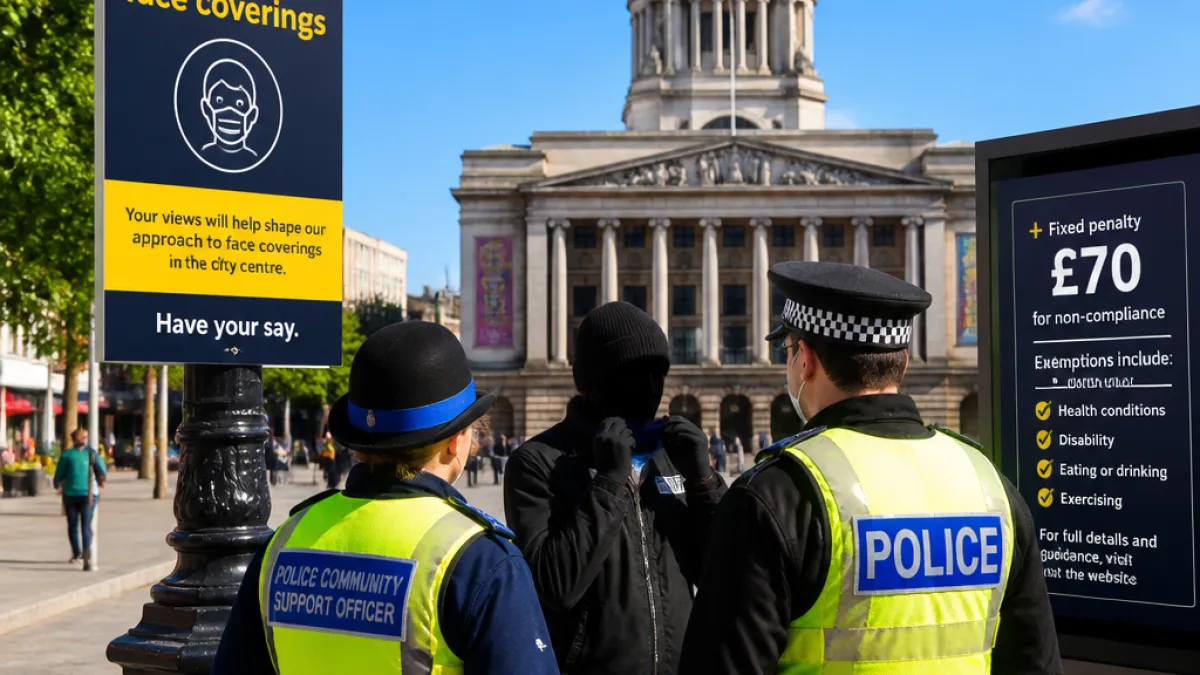
Nottingham City Council has opened a public consultation on proposals to ban certain face coverings in the city centre, giving police officers and community protection officers the power to require removal where they reasonably believe a covering is being used to conceal identity for the purpose of committing crime or anti‑social behaviour.
What the proposals say
Under the plans, officers could ask people to remove face coverings if they judge them to be worn to hide identity while committing offences such as vandalism or other anti‑social acts. Failure to comply could result in an on‑the‑spot fine of £70 or prosecution with a maximum fine of £1,000.
- Who could enforce: police and community protection officers.
- Penalties: £70 fixed penalty notice or prosecution up to £1,000.
- Exemptions: coverings worn for religious, cultural, health, work, weather or personal safety reasons.
Context: link to existing PSPO
The proposed ban would be added to a public spaces protection order (PSPO) that Nottingham City Council introduced in July to tackle a range of behaviours in the city centre. The PSPO already contains measures aimed at aggressive charity collections, noisy buskers, public urination and unauthorised sales of the Big Issue. Concerns about face coverings emerged during a separate consultation on the PSPO, prompting this targeted proposal.
Matt Shannon, Nottingham City Council's executive member for neighbourhoods, waste and equalities, said the authority was "listening to what the people of Nottingham want to make the city safer" and linked the measure to reducing low‑level anti‑social behaviour and helping police tackle drug networks.
"You get low‑level anti‑social behaviour like graffiti and vandalism where people feel like they're immune because they cover their face and aren't caught on CCTV," Shannon said. "On the other hand, we're working with police to help tackle drug networks. If you have drug couriers rushing through the city, you don't want them covering their face, you want them to be open to be stopped and seen for who they are."
How exemptions and discretion would work
Council materials state the ban would not apply where faces are covered for legitimate reasons. Those listed include religious and cultural observance, health, work requirements, weather protection and personal safety. The proposals place responsibility on officers to determine whether a covering is legitimately worn, with the council emphasising that there will be "a lot of common sense" and scope for on‑the‑spot judgement about whether someone is intentionally harassing or intimidating.
That discretionary element is central to how the policy would operate in practice. It will be for individual officers to balance public safety concerns with the rights of people to wear coverings for legitimate purposes. The council has said it does not expect the ban to create community tensions and believes it will "make people feel safer around the city and reduce tensions overall."
Local reaction and next steps
The consultation opens the formal process for gathering public views before any change is made to the PSPO. If approved, the face covering measure would become an additional enforceable condition within the existing order. The consultation also provides residents and stakeholders with an opportunity to raise concerns about how exemptions will be recognised and how officers will apply discretion on the ground.
Questions likely to arise during the consultation include how officers will assess legitimate reasons for coverings, training for community protection officers and police on cultural and religious sensitivities, and how enforcement will be recorded and reviewed. The council has framed the measure as targeted at concealment linked to criminality and anti‑social behaviour rather than a general ban.
| Aspect | Detail |
|---|---|
| Enforcing bodies | Police; community protection officers |
| Fixed penalty | £70 |
| Maximum prosecution fine | £1,000 |
The consultation will determine whether the policy is adopted as an amendment to the PSPO. Residents and organisations across Nottingham will be able to submit views on the proposals; the council will consider responses before deciding whether to proceed.